

Roof Anchor Inspection & Certification
Annual anchor inspections, load testing and certification through S&K's long-time anchor partner, with the records you hand to ownership, insurers and the contractors who use your roof.
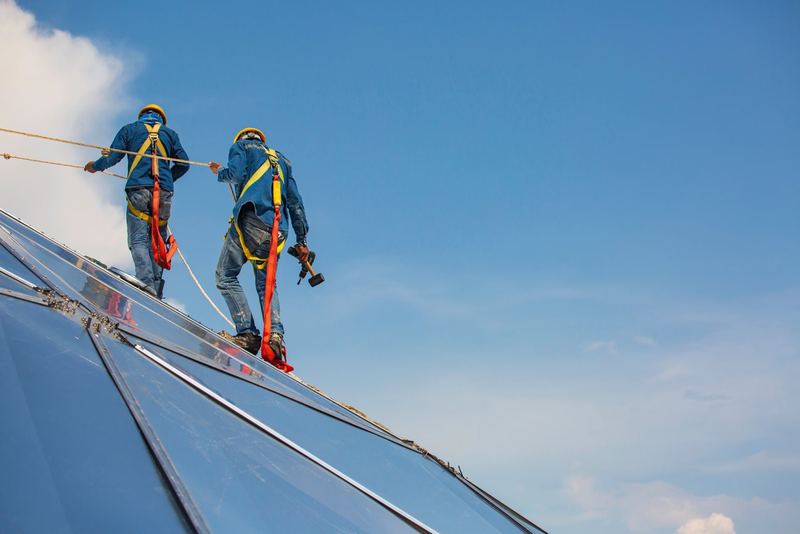
Two clocks run on every roof anchor
Under OSHA 29 CFR 1910.27(b)(1), before any rope descent work, the building owner must confirm in writing that each anchorage has been identified, tested, certified and maintained to hold at least 5,000 pounds in any direction for each worker attached.
- Every year: a qualified person inspects each anchorage.
- At least every 10 years: a qualified person certifies it. Ten years is the maximum, not the target.
- No confirmation, no rope work: the contractor may not use an anchorage without it.
Inspection, testing and certification, one request
One request to S&K covers it. Our long-time anchor partner does the inspection, load testing and certification, and installs new anchors where gaps exist.
Annual Inspection
Every anchor on the roof, every year, so the owner's written confirmation rests on a current inspection.
Load Testing
Testing that confirms what each anchor can hold, so certification rests on evidence.
Certification & Recertification
Certification of new and existing anchor systems, and recertification before the cycle lapses.
Deficiencies Flagged
Anything that needs repair or replacement, called out before a crew ties off to it.
Compliance Documentation
Inspection and certification records suitable for ownership, insurers and compliance reviews.
Installation Where Gaps Exist
Engineered anchor points for drops that cannot be rigged safely today. See anchor installation.
When anchors need recertifying early
The rule also requires certification "as necessary." Anything that could change what an anchor can hold is a reason to recertify before the next rope descent job.
| What happened | Why it matters |
|---|---|
| Reroofing or membrane work | Roof work around the anchors can change their condition. Reinspect and recertify before the next job. |
| Structural changes | Work on the roof or parapet can change what an anchor is attached to. |
| Corrosion, damage or movement | Found at the annual inspection, it takes the anchor out of service until it is repaired, retested and recertified. |
| Repair or relocation | A repaired or moved anchor needs certifying in its new condition. |
| A fall arrest or shock load | An anchor that has taken a load like that cannot be assumed to hold its rating. |
| Missing records | Records you cannot trace to a qualified person cannot support the owner's written confirmation. |
The duty sits with the owner, even when it is delegated
Property managers usually run the anchor program. Contractors must see the owner's written confirmation before they tie off. S&K can handle it on the owner's side, from inspection and certification to the documentation.
No records?
Rope descent work cannot start. The path forward is inspection, testing and certification by a qualified person. See how to find certification records.
An anchor failed?
That anchor cannot be used. Take it out of service, then repair or replace, retest and recertify. See what to do when an anchor fails.
What should the report show?
Anchor-by-anchor detail, not "anchors inspected, OK." See what a defensible inspection report contains.
One contact for your anchors and the work that depends on them
- Installation, inspection, load testing and certification through our long-time anchor partner
- 100% W2 technicians: trained, insured S&K employees
- Technicians certified before any at-height work
- Site-specific safety plans and equipment inspected on a routine schedule
- Records you can hand to ownership, insurers or auditors
Anchor inspection questions
Every year, by a qualified person. Each anchorage must also be certified as necessary and at least every 10 years, under OSHA 29 CFR 1910.27(b)(1).
The building owner. Before rope descent work, the owner must confirm in writing that each anchorage has been identified, tested, certified and maintained. Property managers usually run the program on the owner's behalf.
Not always. OSHA accepts scientifically valid testing criteria chosen by a qualified person. It has cited testing an anchorage with a 5,000-pound ultimate capacity and a four-to-one safety factor at 2,500 pounds as acceptable.
The contractor cannot use them for rope descent work, so high-rise window cleaning and facade work stop. Uncertified anchors also expose the owner to serious OSHA liability.
Yes. Through our long-time anchor partner, we inspect, test and certify existing anchor systems, and flag anything that needs repair or replacement.
S&K's long-time anchor partner. You request it through S&K, and S&K's W2 technicians do the window cleaning and facade work that depends on the anchors.
Yes. You receive inspection and certification records suitable for ownership, insurers, and compliance reviews.
Not sure where your anchors stand? Book a free roof compliance survey, or get the free Roof Anchor Compliance Checklist.
Find out where your anchors stand
Tell us about your building and we will follow up. On the form, select Anchor Installation / Inspection & Certification.
Request an Anchor Inspection