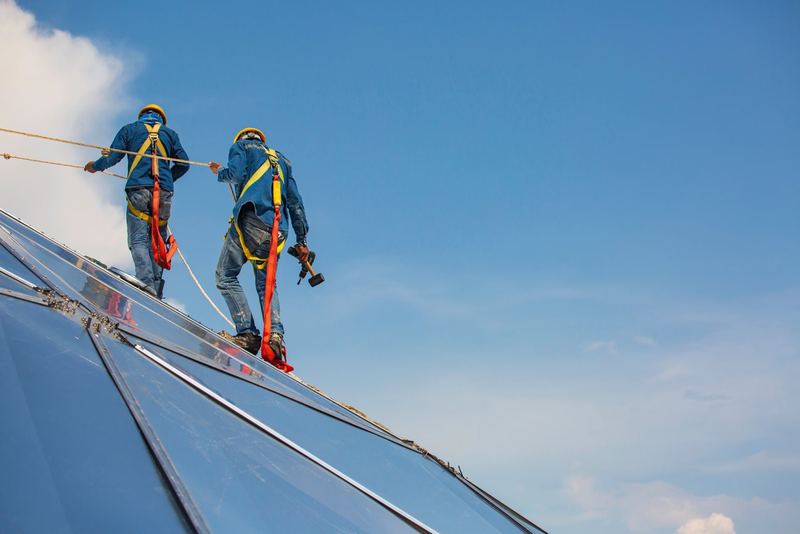
If anyone cleans or maintains your facade from the roof down, OSHA puts the anchors on the building owner. Before any rope descent work, the owner must confirm in writing that every anchorage has been identified, tested, certified and maintained to hold 5,000 pounds per worker. This guide explains the rule in plain language, the inspection and certification cycle, and what to do when anchors are missing, expired or failing.
What OSHA 1910.27(b)(1) requires, in plain language
The rule applies to every anchorage used with a rope descent system, the method most high-rise window cleaning relies on.
The rule says
What it means for your building
Identify each anchorage
Know where every anchor on the roof is, ideally on a roof plan with each one labeled.
Test each anchorage
A qualified person tests it using scientifically valid criteria.
Certify each anchorage
A qualified person certifies it as necessary, and at least every 10 years.
Maintain each anchorage
Keep it in certified condition, backed by an annual inspection by a qualified person.
5,000 pounds, any direction, per worker
Each anchorage must hold at least 5,000 pounds in any direction for each worker attached.
Inform the employer in writing
Before any rope descent work, give the contractor written confirmation of all of the above.
The contractor's side
The contractor may not use an anchorage without that confirmation, and keeps it for the duration of the job.
Source: OSHA 29 CFR 1910.27(b)(1). A plain-language summary, not legal advice.
The certification cycle: annual inspections, ten-year certification
Two clocks run at the same time:
Every year: a qualified person inspects each anchorage. This is the basis for the owner's written confirmation.
At least every 10 years: a qualified person certifies each anchorage. Ten years is the maximum, not the target.
The rule also requires certification "as necessary." In practice, anything that could change what an anchor can hold is a reason to recertify before the next rope descent job:
Reroofing or membrane work around the anchors
Structural changes to the roof or parapet
Corrosion, damage or movement found at the annual inspection
Repairs to, or relocation of, an anchor
An anchor that has arrested a fall or taken a shock load
Records that are missing or cannot be traced to a qualified person
Keep the most recent certification date for every anchor, and plan the next one before it lapses.
How testing works
Testing does not always mean pulling 5,000 pounds on every anchor. In a 2019 interpretation, OSHA said the qualified person may use any scientifically valid testing criteria: generally, criteria accepted by an industry consensus group or certified by a registered professional engineer. OSHA gave the example of an anchorage with a 5,000-pound ultimate capacity and a four-to-one safety factor, tested at 2,500 pounds, as acceptable. Testing to the full 5,000 pounds is also acceptable where a consensus standard requires it or the qualified person decides it is necessary.
ANSI/IWCA I-14.1 and how it relates to the OSHA rule
What it is. ANSI/IWCA I-14.1 is the window cleaning safety standard published by the International Window Cleaning Association and approved by the American National Standards Institute in 2001. It covers safe practices for window cleaning, including how buildings and anchors support safe rigging.
How it relates. OSHA drew on it when writing its walking-working surfaces rules, and many of the same principles now sit in 1910.27. OSHA does not cite violations of ANSI standards it has not adopted, but it does use them as evidence of recognized hazards and feasible fixes, including under the General Duty Clause.
What it means for you. Treat OSHA 1910.27 as the legal floor and I-14.1 as the industry's recognized practice. A defensible anchor program meets both.
Who holds the obligation
Party
What they are responsible for
Building owner
The legal duty under 1910.27(b)(1): identify, test, certify and maintain each anchorage, and confirm it in writing before rope descent work.
Property manager
Usually runs the anchor program for the owner: schedules inspections, keeps records and hands them to contractors. Check your management agreement.
Contractor
Must obtain the owner's written confirmation before anyone uses an anchorage, keep it for the job, and follow OSHA's rope descent rules.
Qualified person
Performs the inspections, tests and certifications the owner relies on. Often a specialist firm hired by the owner or manager.
The duty sits with the owner even when the work is delegated. S&K can handle it on the owner's side: through our long-time anchor partner, we inspect, load test and certify anchor systems and provide the documentation. See anchor installation and inspection.
Anchor types and what each is rated for
Anchor type
What it is used for
Rating requirement
Roof anchors (tie-back or tie-off points)
Rope descent main and safety lines, and personal fall arrest
Rope descent: at least 5,000 lb in any direction per worker attached (1910.27(b)(1)). Fall arrest: 5,000 lb per worker, or engineered by a qualified person with a safety factor of at least two (1910.140(c)(13))
Davit systems
Bases and arms that suspend rope or stage rigging out past the roof edge
Used with rope descent, the anchorage must meet the 1910.27(b)(1) requirement. Rated and certified for the rigging it supports
Horizontal lifelines and rail systems
Fall protection for workers moving along a roof edge
Engineered systems, designed and installed under a qualified person (1910.140(c)(13))
Permanent powered platforms
Building-owned suspended platforms for facade maintenance
OSHA 1910.66: the owner confirms in writing that the installation has been inspected, tested and maintained, and its anchorages meet 1910.140(c)(13)
"In any direction" matters. Rope loads rarely pull straight down, so the certification has to cover the angles the anchor will actually see.
What a defensible inspection report contains
If an insurer, auditor or OSHA asks, the report is your evidence. It should include:
The building address and a roof plan with every anchor labeled
For each anchor: ID, location, type and manufacturer where known
Inspection date, and the name and qualifications of the qualified person
The inspection method and testing criteria used, including any test load and result
Pass or fail for each anchor, with photos of any defect
Deficiencies found and the required repair, replacement or restriction
A certification statement of capacity: at least 5,000 lb in any direction per worker attached
The date of the next annual inspection and the certification due date
The signature of the qualified person
A report that only says "anchors inspected, OK" will not hold up. Ask for anchor-by-anchor detail.
Failure scenarios and remediation paths
What you find
What it means
The path forward
No records, or records you cannot trace
You cannot give the written confirmation, so rope descent work cannot start
Inspection, testing and certification by a qualified person
Certification older than 10 years
Out of compliance even if the anchors look fine
Recertification
An anchor fails inspection or testing
That anchor cannot be used
Take it out of service, then repair or replace, retest and recertify
Roof work around the anchors
Their condition may have changed
Reinspection and recertification before the next job
Anchors in the wrong places for the facade
Some drops cannot be rigged safely
Engineered additional anchors to close the gaps
Unknown or unrated anchors
Capacity cannot be confirmed
Engineering evaluation and testing, or replacement
Uncertified anchors expose the property owner to serious OSHA liability and can halt all high-rise work. Through its long-time anchor partner, S&K flags anything that needs repair or replacement, and installs new engineered anchors where they are needed.
Buildings with no anchors: compliant alternatives
Install engineered anchors. Anchor points designed for window cleaning and facade access, laid out for the drops the facade needs, then certified.
Use ground-based access where height allows. Water-fed poles and aerial lifts reach storefront and mid-rise glass without roof anchors. See Storefront (1-3 stories) and Mid-Rise (4-7 stories).
Do not improvise. Without a certified anchorage and the owner's written confirmation, rope descent work cannot legally start.
On the form, select Anchor Installation / Inspection & Certification.
Frequently asked questions
How often do roof anchors need to be inspected?
Every year, by a qualified person. Each anchorage must also be certified as necessary and at least every 10 years, under OSHA 29 CFR 1910.27(b)(1).
Who is responsible for roof anchor certification?
The building owner. Before rope descent work, the owner must confirm in writing that each anchorage has been identified, tested, certified and maintained. Property managers usually run the program on the owner's behalf.
Do roof anchors have to be load tested to 5,000 pounds?
Not always. OSHA accepts scientifically valid testing criteria chosen by a qualified person. It has cited testing an anchorage with a 5,000-pound ultimate capacity and a four-to-one safety factor at 2,500 pounds as acceptable.
What happens if my roof anchors are not certified?
The contractor cannot use them for rope descent work, so high-rise window cleaning and facade work stop. Uncertified anchors also expose the owner to serious OSHA liability.
Is ANSI/IWCA I-14.1 mandatory?
OSHA does not cite violations of ANSI standards it has not adopted, but it uses them as evidence of recognized hazards and feasible fixes. Treat I-14.1 as recognized industry practice alongside the OSHA rule.