The short answer
- Mid-rise, 4 to 7 stories: quarterly exterior cleaning is the common baseline for office and managed commercial buildings.
- High-rise and towers, 8+ stories: the full facade is typically cleaned once or twice a year on a planned program.
- Entrances and lobbies at any height: monthly, because they get the most traffic and the most eyes.
Why taller buildings run on longer cycles
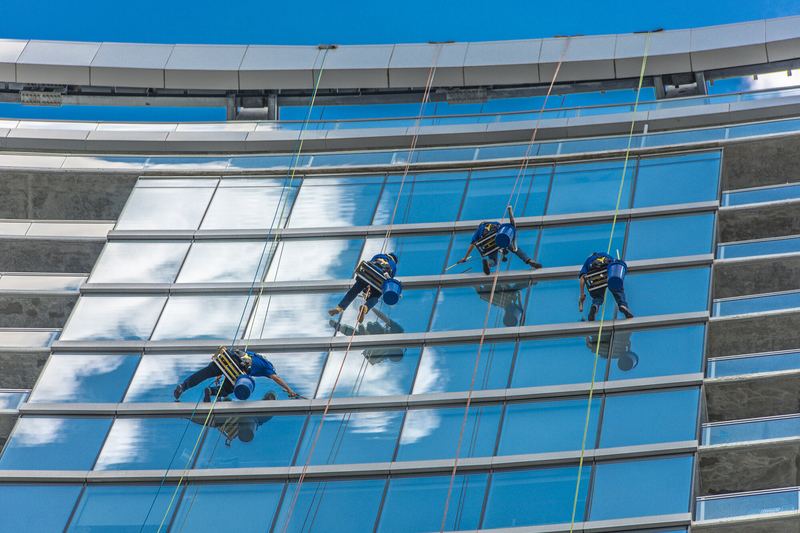
Lifts, swing stages and rope access carry higher mobilization costs than ground-level work. That pushes high-rise facades onto a planned program, timed to stay ahead of buildup before it turns into etching.
Frequency by building and glass
| Building | Exterior facade | Entrances and lobbies | Interior glass |
|---|---|---|---|
| Mid-rise office and managed CRE | Quarterly | Monthly | Quarterly or semi-annual |
| High-rise, 8 to 15 stories | Once or twice a year | Monthly | Quarterly or semi-annual |
| Tower, 16+ stories | Once or twice a year | Monthly | Planned, often in winter |
What pushes frequency up
- Nearby construction, highways or rail
- Heavy tree cover
- Irrigation overspray, which leaves hard-water minerals that bond to glass
- High visibility: Class A office, retail frontage, buildings competing for tenants
What happens if you stretch the interval
Deferred cleaning does not stay cosmetic. Mineral deposits from overspray, runoff and pollution bond to the glass and etch it. Once that happens, cleaning no longer fixes it. Restoration does, at a higher cost per pane, and deep etching means replacement, which runs into the thousands per opening. See hard water and mineral staining: cleaning vs. restoration.
How the year usually runs
- Spring: post-winter facade and window cleaning.
- Summer: peak season for high-rise and rope-access work.
- Fall: pre-winter cleaning and annual roof anchor inspection.
- Winter: interior and atrium glass, and budgeting next year.
Build a full program in the annual maintenance planning center, or see how frequency changes at each height in Commercial Window Cleaning by Building Height.