What Professional Window Cleaners Use on Commercial Glass
The cleaning solution, tools and access equipment professionals use on commercial glass, what they never use, and what to ask a contractor before work starts.


Height decides how your glass gets cleaned. It sets the access method, the access method sets the labor per pane, and above seven stories it brings roof anchors and OSHA requirements onto the owner's side of the table. This guide covers each height tier, what a compliant scope must include, and who is responsible for what.
Find your building's row. Height sets the access, the facade shapes the plan, and the roof decides what is possible above seven stories.
| Height tier | Typical access | Facade and glass | Roof equipment needed |
|---|---|---|---|
| Storefront (1-3 stories) | Hand cleaning and pure-water poles from the ground | Storefront, entrance and door glass | None |
| Mid-rise (4-7 stories) | Water-fed poles, aerial lifts and ladders | Mixed elevations, lobby and tenant glass | None. Access is from the ground or a lift |
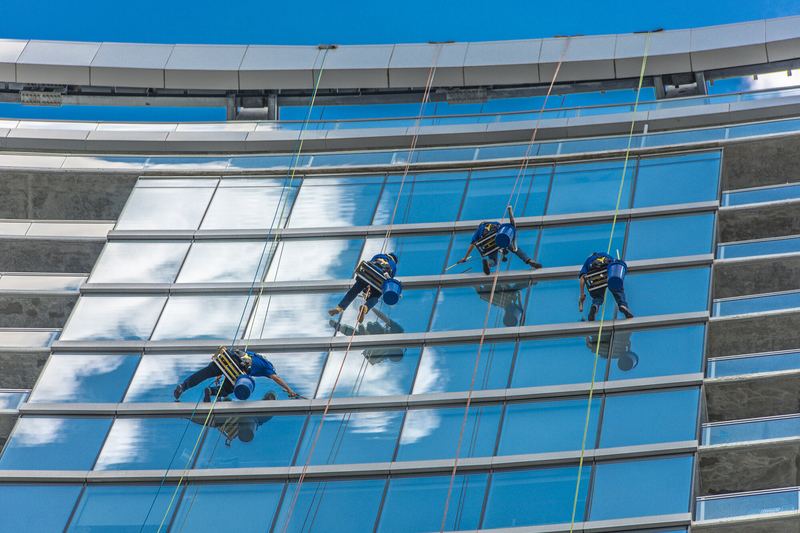
| High-rise (8-15 stories) | Rope descent and swing stages, worked from the roof down | Full facade and curtain wall | Certified roof anchors, confirmed in writing by the owner |
| Tower (16+ stories) | Rope descent and swing stages, set by anchor layout and height | Curtain wall, atriums and skylights | Certified roof anchors. Rope descent is limited to 300 feet above grade unless other means are not feasible |
Atriums, skylights and setbacks need specialty access at any height, and the walkthrough confirms the plan. Anchor and height requirements: OSHA 29 CFR 1910.27.
Pole and hand cleaning from the ground. Frequent visits, low cost per visit, one standard at every location.
Read the guide02Pole, lift and ladder access for office and managed buildings. Quarterly baseline, monthly for lobbies.
Read the guide03Rope descent and swing stage access from certified roof anchors. Planned once or twice a year.
Read the guide04Access set by the roof: certified anchors, height limits and a planned drop schedule, documented end to end.
Read the guideA scope that only says "clean the windows" invites a low bid and a bad outcome. A compliant scope spells out:
With every bid priced against the same scope, you compare line by line, not on the total.
Work at height splits responsibility between the building and the contractor. Knowing the split keeps a job from stalling on the roof.
| Area | Property manager or owner | Contractor |
|---|---|---|
| Roof anchors | Identify, test, certify and maintain each anchorage. Give the contractor written confirmation before rope descent work. | Verify anchors before any drop. Use no anchorage without the owner's written confirmation. |
| Safety | Share roof access requirements and known building hazards. | A site-specific safety plan, certified technicians and inspected equipment. |
| Insurance | Require a certificate of insurance naming the property. | Carry general liability and workers comp, and provide the certificate. |
| Operations | Roof access, tenant notice and the ground-level areas below the work. | Schedule, crew assignment and a clear work plan. |
| Records | Keep anchor certifications and vendor documents on file. | Provide inspection, certification and safety documentation. |
The anchor side does not have to be yours to manage. Through its long-time anchor partner, S&K installs, inspects, load tests and certifies anchor systems and hands you the records. See anchor installation and inspection and the roof anchor and fall protection compliance guide.
| Building and glass | Typical frequency |
|---|---|
| Storefront and ground-floor retail | Weekly, bi-weekly or monthly |
| Class A office and managed commercial real estate, exterior | Quarterly |
| Office lobbies, atriums and busy entrances | Monthly |
| Office interior glass | Quarterly or semi-annual |
| High-rise and tower facades | Once or twice a year, on a planned program |
What pushes frequency up:
How the year runs:
Your local team tailors the cadence to your building. Build a full program in the annual maintenance planning center.
Start with a ballpark from the pricing calculator, or ask for our safety documentation and certificates of insurance.
The cleaning solution, tools and access equipment professionals use on commercial glass, what they never use, and what to ask a contractor before work starts.
Roof anchors, davit bases or a permanent platform: what is already on your roof decides how your facade can be cleaned. Here is how to find out, and why it matters.
A continuous glass curtain wall and a masonry wall with punched windows clean very differently. Here is how glazing type changes access, time and cost.
Spots that routine cleaning will not lift are a warning. Here is how to tell whether commercial glass needs cleaning or restoration, and how to stop it happening again.
High-rise window cleaning needs space on the ground as well as the roof. Here is what to plan for safety zones, sidewalks, parking and staging before the first drop.
Mid-rise buildings usually run quarterly. High-rise and tower facades run once or twice a year. Here is what moves your building up or down.
Exterior glass is usually the landlord's job. Interior glass depends on the lease. Here is how to scope both sides without gaps or double billing.
Rope descent and swing stages both reach high-rise glass from the roof. Height, anchors, facade shape and scope decide which one fits your building.
Water-fed poles clean upper-floor glass from the ground. Here is where they fit, what limits their reach on a real facade, and when lifts or rope access take over.
Three bids, three very different numbers, one building. Here is what drives the spread, and how to compare window cleaning bids on the same footing.
Class A buildings are held to a higher visual standard than Class B and C. Here is how asset class shapes window cleaning frequency, and where the floor is.
When a contractor works at height on your building, their safety record becomes your liability. Here is what the property manager is responsible for.
A vague scope gets a low bid and a bad outcome. These are the items a commercial window cleaning scope of work has to spell out, in order.
Window cleaning in an occupied building runs on coordination. Here is what tenant notices should say, how to handle access, and when after-hours work makes sense.
Wind, rain and peak season decide when multi-story glass can actually be cleaned. Here is how to plan for it, and what to put in the contract.
Local S&K teams in 20 markets. Find the branch that services your property.
Tell us the height, the glass and the roof. We route every request to the local S&K team that services your market.
Request a Quote