The short answer
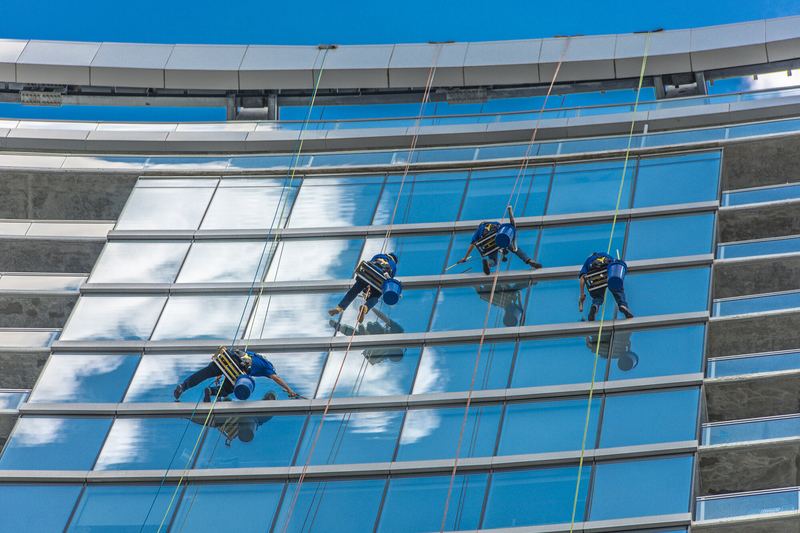
Both methods hang from the roof. A rope descent system lowers one technician down the facade on a controlled line. Suspended scaffolding, usually called a swing stage, is a platform hung from the roof that carries crew and equipment.
Rope descent fits routine cleaning on facades with certified anchors. A swing stage fits when the work needs a platform: more equipment, more time at each pane, restoration work, or heights where rope descent is restricted. Five factors decide it.
1. Building height
OSHA limits rope descent systems to 300 feet above grade unless the contractor can show that other means are not feasible or pose a greater hazard (29 CFR 1910.27). On most buildings in the High-Rise (8-15 stories) range, height is not the constraint. On the tallest towers, it can be.
2. Roof anchors and their paperwork
Under OSHA 29 CFR 1910.27, before any rope descent system is used, the building owner must confirm in writing that each anchorage has been identified, tested, certified and maintained to support at least 5,000 pounds in any direction for each worker attached, based on an annual inspection and certification at least every 10 years.
No written confirmation, no rope descent. If the anchors are missing, uncertified or in the wrong places, that shapes the method before anything else does. See the roof anchor and fall protection compliance guide.
3. Facade geometry
- Setbacks and overhangs interrupt a straight drop and may need re-rigging mid-facade.
- Sloped or stepped glass can keep a single line from reaching the surface.
- Obstructions like signage, sunshades and ledges change where a line or a stage can travel.
4. The scope of work
- Routine cleaning: rope descent is built for it. Light, mobile, one drop at a time.
- Restoration and repair: sanding, buffing and polishing glass takes tools and time at each pane, which usually favors a stable platform.
- Mixed scopes: many buildings use rope descent for cleaning and a stage for restoration on the same facade.
5. Schedule and disruption
A swing stage takes more rigging on the roof and more coordination at ground level. Rope descent sets up lighter and moves between drops faster. Either way, the ground below the work has to be controlled. See staging, parking and sidewalk closure requirements.
Safety rules that apply to rope descent
- Each worker uses a separate, independent personal fall arrest system.
- Prompt rescue has to be available in the event of a fall.
- No rope descent work in hazardous weather, such as storms or gusty or excessive wind.
- Tools, squeegees and buckets are secured by a tool lanyard or similar method so they cannot fall.
All four come from OSHA 29 CFR 1910.27. If your building has a permanently installed powered platform, a different standard applies. See what building access equipment you already have.
Rope descent vs. swing stage at a glance
| Rope descent system | Suspended scaffolding (swing stage) | |
|---|---|---|
| What it is | One technician on a controlled descent line | A platform suspended from the roof |
| Best for | Routine cleaning, drop by drop | Restoration, repair, heavier equipment |
| Setup | Lighter, moves between drops quickly | More rigging and ground coordination |
| Depends on | Certified anchors and owner's written confirmation | Roof support points and rigging plan |
| Height | Limited to 300 ft above grade unless other means are not feasible | Used where rope descent does not fit |
How S&K chooses the method
The walkthrough starts on the roof: anchor locations, certification status and the facade below them. From there we set the method elevation by elevation, with rope-descent and swing-stage crews, and write a site-specific safety plan. Tie-off every time.
- 100% W2 crews. Trained, insured S&K employees, never subcontractors.
- A site-specific safety plan for every at-height job, with anchor verification and a certified crew assigned.
- Equipment inspected on a schedule. Lifts, swing stages and rope-access gear are inspected and serviced routinely.
- Certificates of insurance on request, and documentation you can hand to ownership, insurers or auditors.